Planning a Texas Hold’em tournament at home doesn’t have to be complicated. Whether you’re inviting eight friends or running a multi-table poker night, the key is having your blinds, chips, seating, and payouts organized before the first hand.
In this guide, you’ll learn how to run a home poker tournament step by step, including setting starting stacks, building a blind schedule, managing rebuys, and tracking results. You’ll also see how tools like TableAce can help you spend less time running the tournament and more time playing.
1. Decide How Many Players to Invite
For a first home tournament, six to ten players is a manageable number for one table. Larger games need additional tables and a plan for balancing them as players are eliminated.
| Players | Suggested setup |
|---|---|
| 2–6 | One small table |
| 7–10 | One full table |
| 11–20 | Two or more tables |
| 21+ | Multiple tables with balancing |
Confirm attendance ahead of time so you have enough seats, chips, and supplies.
2. Set the Buy-In and Starting Chip Stack
Choose the same starting stack for each player. For example, you could use a 10,000-chip starting stack with 25/50 opening blinds. If your game uses a monetary buy-in, make sure it complies with local laws.
Example 10,000-chip starting stack
| Chip value | Quantity | Total |
|---|---|---|
| 25 | 8 | 200 |
| 100 | 8 | 800 |
| 500 | 8 | 4,000 |
| 1,000 | 5 | 5,000 |
| Total | 29 | 10,000 |
Prepare enough chips for everyone, with extras if you plan to allow rebuys or add-ons.
3. Create Your Tournament Blind Structure
Blinds rise throughout a tournament to keep play moving. Fifteen- to twenty-minute levels work well for many casual games, while shorter levels speed things up.
Example home poker tournament blinds
| Level | Small blind | Big blind | Duration |
|---|---|---|---|
| 1 | 25 | 50 | 15 min |
| 2 | 50 | 100 | 15 min |
| 3 | 75 | 150 | 15 min |
| 4 | 100 | 200 | 15 min |
| Break | — | — | 10 min |
| 5 | 150 | 300 | 15 min |
| 6 | 200 | 400 | 15 min |
| 7 | 300 | 600 | 15 min |
| 8 | 400 | 800 | 15 min |
| 9 | 600 | 1,200 | 15 min |
| 10 | 800 | 1,600 | 15 min |
| 11 | 1,000 | 2,000 | 15 min |
| 12 | 1,500 | 3,000 | 15 min |
Add levels if needed. Tournament length varies with player count, stacks, blind increases, and rebuys. A 10,000-chip starting stack with 25/50 blinds begins at 200 big blinds, allowing more room for play than the same stack with 100/200 blinds. Faster blind increases generally shorten the game; plan your schedule around your group’s available time.
4. Decide Whether to Allow Rebuys and Add-Ons
A rebuy lets an eligible player buy another stack during a defined period. An add-on offers eligible players extra chips at a specified time, often a break. For example, a host might offer a 10,000-chip rebuy during the first four levels and a 5,000-chip add-on at the first break.
Announce the price, chip amount, eligibility rules, and exact rebuy cutoff level or time before play begins. Remind players when the rebuy period is about to close, and keep a record of every transaction.
5. Decide How Prizes Will Be Distributed
Agree on the payout percentages before the first hand. Here’s a simple example for a $200 prize pool:
| Finish | Share | Amount |
|---|---|---|
| 1st | 50% | $100 |
| 2nd | 30% | $60 |
| 3rd | 20% | $40 |
| Total | 100% | $200 |
If permitted by local law, include eligible buy-ins, rebuys, and add-ons in the pool calculation. These numbers are illustrations, not legal guidance.
6. Assign Players to Tables and Seats
Random seat assignments help keep the game fair. With multiple tables, distribute players as evenly as possible, then plan how to move players as tables shrink.
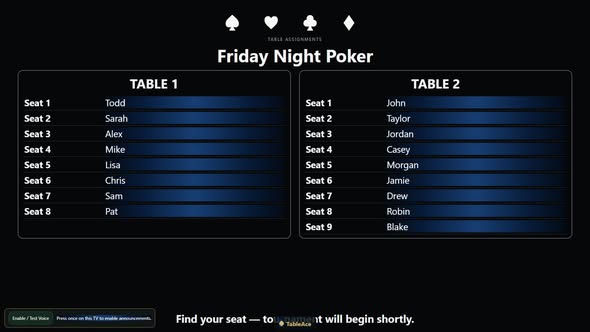
For example, 16 players could start at two tables of eight. If eliminations leave one table with eight players and another with six, moving one player creates two tables of seven. As the field shrinks further, you may need to combine tables. TableAce includes seating and table-balancing tools to help hosts organize this process.
7. Track Eliminations and Results
Record each player’s finishing position as they are eliminated. If you host weekly tournaments, keeping results over time makes it easier to review performance and past winners.
8. Put Your Tournament Clock on the TV
A visible clock makes it easy for players to see the current blinds and time remaining without repeatedly asking the host. A TV tournament display can also show upcoming blinds, players remaining, and other game information.
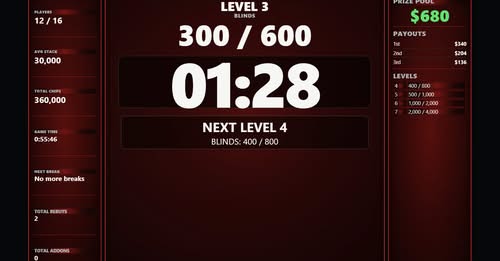
With TableAce, the host can manage tournament controls from a phone while the TV shows the game information to everyone.
9. Make Home Tournament Management Easier With TableAce
TableAce was built by a poker player for poker players. It brings together a blind timer, TV display, player registration and check-in, seating, table balancing, rebuy and add-on tracking, and tournament results in one system.
Instead of juggling paper lists, a separate clock, and spreadsheets, you can focus more on playing and less on running the game.
Explore TableAce and make your next poker night easier →
10. Home Poker Tournament Checklist
- Confirm players and seating capacity.
- Prepare chips and choose starting stacks.
- Set blind levels and breaks.
- Explain rebuy and add-on rules.
- Agree on payouts and house rules.
- Assign seats and set up the clock.
- Test the TV display and sound alerts before players arrive.
- Track eliminations and final results.
Frequently Asked Questions
How many players do you need for a home poker tournament?
You can run a tournament with only a few players, but six to ten is a practical starting point for a single-table home game.
How long should blind levels last?
Many casual home games use 15- to 20-minute levels. Choose shorter levels for a faster tournament or longer levels for more play.
How many chips should each player start with?
There is no universal number. A 10,000-chip stack is easy to work with, but the stack’s size relative to opening blinds matters more than the printed chip values.
How long does a home poker tournament take?
Small games may take two to four hours, but the number of players, blind structure, and rebuy rules can change the duration substantially.
What’s the easiest way to manage a home poker tournament?
Prepare the rules ahead of time and use a dedicated tournament clock or management tool. TableAce helps hosts organize multiple tournament tasks in one place.
Want a quick preparation list? Read our Home Poker Tournament Host’s Checklist for the steps to complete before your players arrive.
Around the table